Mobile Beauty Therapist Lash Lift Kit UK: What to Check Before Restocking
Direct answer: a mobile beauty therapist should restock a lash lift kit only when it fits their training, client consultation process, product labelling checks, COSHH thinking, hygiene workflow and aftercare records. A cheaper or convenient kit is not enough if you cannot show how it is used safely and consistently with clients.
This is a business decision, not just a product decision. You are carrying products into clients' homes, working close to the eye and relying on repeatable process. HSE COSHH guidance for beauticians notes that some beauty product ingredients can irritate skin or cause allergy, and that controls can include ventilation, good technique, hand care and PPE depending on the treatment. That does not mean every small therapist needs a corporate binder. It means you need a clear, usable way to control the real task.
Restock decision table
| Check | Proceed when | Do not proceed when |
|---|---|---|
| Training fit | Your qualification or course covers lash lifting or eyelash perming. | You are relying on product instructions alone for paid client work. |
| Product information | English instructions, precautions, batch details, ingredients and responsible contact details are clear. | Labels are vague, missing or hard to understand. |
| COSHH thinking | You know the task, exposure points, ventilation and PPE or hygiene controls. | You only keep a safety sheet but have not considered the actual treatment. |
| Client records | Patch test, consultation, consent and aftercare are documented in a repeatable way. | You cannot prove what was checked or advised. |
| Stock handling | Opening dates, storage and single-client hygiene are controlled. | Products travel loose, unlabeled or beyond the stated open period. |
Training and insurance boundaries
BABTAC insurance pre-requisites lists eyelash perming among treatments requiring relevant training routes and also refers to procedures such as patch tests, consultation forms and aftercare. Treat this as a prompt to check your own insurer, membership body and training documents. Do not assume a kit marketed as professional automatically fits your cover.
Product labelling checks
For products sold to consumers in Great Britain, GOV.UK cosmetics guidance says cosmetic products must be safe and should provide clear English information such as precautions, ingredients and Responsible Person details. For a therapist, these are still useful buying checks because they help you answer client questions and avoid anonymous or poorly documented stock.
CTPA rules and regulations guidance also explains that cosmetics sold in the UK and EU must comply with strict cosmetics laws. That is not a shortcut to claiming any single kit is compliant. It is a reason to ask suppliers direct questions and keep evidence where your business can find it.
COSHH without overcomplicating it
Start with the treatment: where product is opened, how close it gets to the eye, how waste is handled, what happens if a bottle leaks in the kit bag, how you ventilate a small room, and what you do if a client reports stinging. HSE COSHH FAQs make a useful point for small operators: safety data sheets do not replace a suitable risk assessment. The sheet is input; your actual mobile treatment is the decision context.
When a consumer-style kit is not enough
A kit may be fine for personal use but not enough for client work if you need larger volumes, batch traceability, professional training support, replacement stock, insurance-compatible documentation or a specific patch-test protocol. If your clients pay for a professional service, your system should be professional even if the physical setup is compact.
Stop conditions
- Stop using a product with clients if labelling, instructions, ingredients or batch details are unclear.
- Stop if your insurer or training route does not cover the treatment.
- Stop if clients report repeated irritation, unexpected reactions or inconsistent results.
- Stop if stock storage, open dates or hygiene controls cannot be verified.
Conditional next step
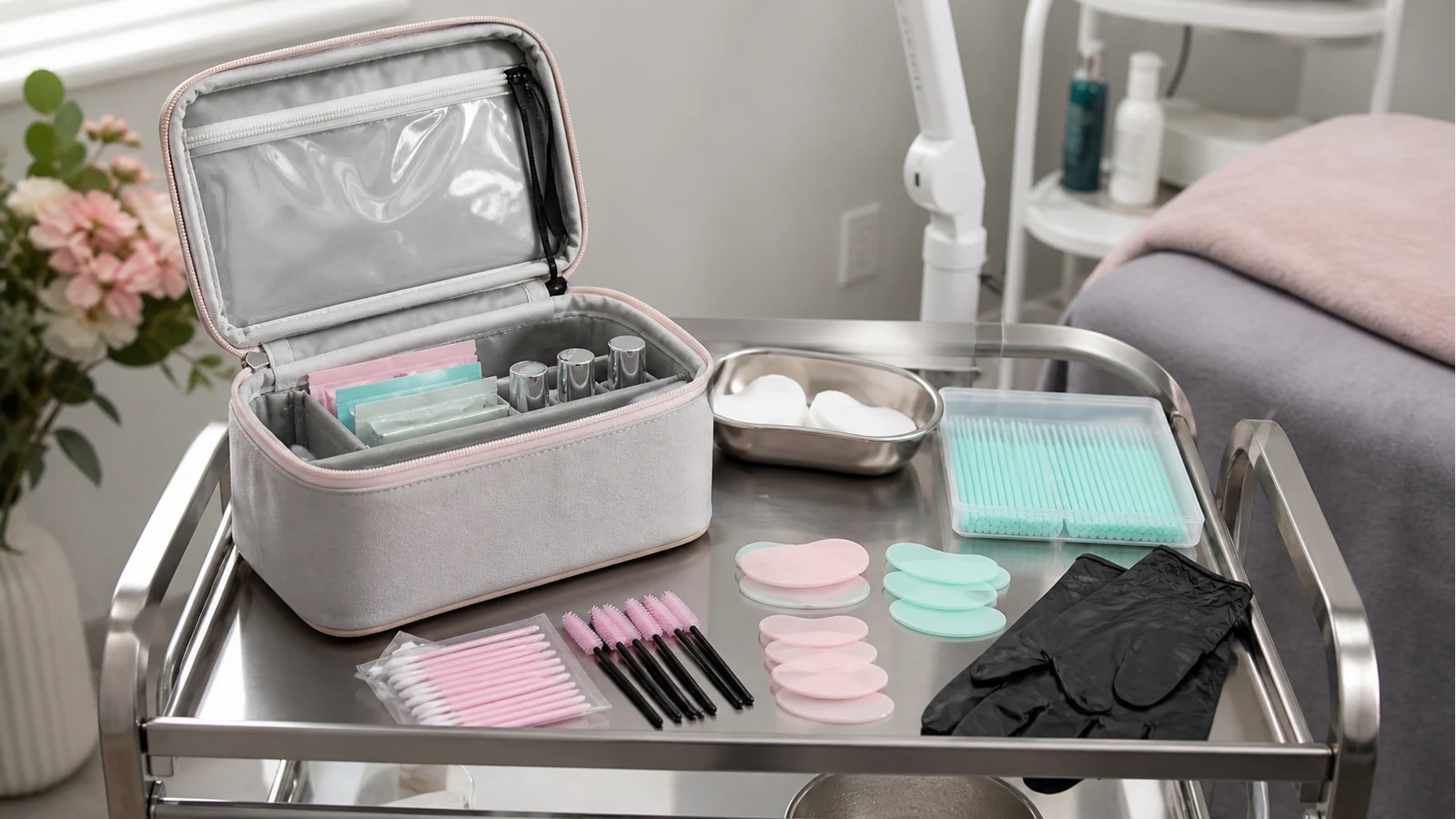
If you are trained, insured, have your records in place and need a backup or small-volume kit for suitable services, the complete lash lifting kit is a same-site route to review. Use it as a candidate to check against your professional requirements, not as proof that your business process is complete.
The client-facing version of your checks
Your client does not need to hear internal compliance language, but they do need a calm explanation of what you checked. In plain English, that means you can tell them you use labelled stock, follow the product instructions, record consultation details, carry out the required patch-test process for your service, and explain aftercare before they leave or before you leave their home.
This builds trust because it maps to the client's real worries: "Will this sting?", "What if I react?", "Can I shower later?", "How long will it last?", and "What do I do if something feels wrong?" A good mobile setup answers those questions before the bottle is opened.
Keep the kit bag boring
Boring is good in a professional kit bag. Products are closed, dates are known, applicators are single-use where they should be, reusable tools are cleaned between clients, and emergency instructions are not buried in a message thread. The more routine the setup, the less you rely on memory while working in different homes and lighting conditions.
How to compare two kits without guessing
Put the two options side by side and ignore the product photos at first. Compare the instructions, opening-life information, pad range, batch traceability, supplier contact route, replacement availability and how easy the format is to use hygienically in a client setting. A tidy bottle or sachet system is only useful if it supports your actual workflow.
Then compare the client conversation. If one product makes it easier to explain patch testing, aftercare, expected limits and what to do if irritation occurs, that product reduces friction in the appointment. If another product is cheaper but leaves you unable to answer those questions clearly, the price saving may be false economy.
Minimum useful record set
For each appointment, keep the client consultation, patch-test status where required by your process, product batch or stock reference, date of treatment, shield choice, timings used according to the product instructions, aftercare given and any follow-up notes. These records do not need to be theatrical. They need to be readable later, especially if a client asks what was used or if you notice a pattern across several appointments.
For restocking, keep a simple stock note: when the item arrived, when it was opened, where it is stored and when it should be replaced. Mobile work adds movement, temperature changes and repeated packing. A small log prevents old or uncertain stock from following you into paid appointments. Uncertain stock should not travel.
When this check is not enough
Do not treat lash-lift guidance as medical advice, a guarantee of results, a reason to skip patch testing, or permission to use chemicals outside the manufacturer instructions.
When to stop and get help
Stop and seek professional or medical help when there is eye pain, swelling, burning, breathing difficulty, broken skin, a failed patch test, uncertain product instructions, or any chemical exposure to the eye.